

Can You Install Pot Lights Without Attic Access?
If your Whitby home lacks attic crawl space, you’re not alone—and you’re not out of lighting options. Many homeowners across the Durham Region live in bungalows, additions, or older homes where attic access is minimal or completely absent. Adding pot lights to an existing ceiling with no attic access is still entirely feasible with the right approach and tools. Energy-efficient LED retrofit recessed lighting systems have revolutionized what’s possible in these spaces, allowing you to enjoy modern lighting upgrades without major demolition.
Brighten up your home with professional Pot Light Installation by Wilson Electric. Our Whitby Electricians and Durham Region Electricians install sleek, energy-efficient lighting with flawless precision.
Common scenarios with inaccessible ceilings
In homes built before 1990 across the Durham Region, key living areas such as living rooms, kitchens, and basement ceilings often have no overhead access. Some are finished with drywall ceilings directly below roof trusses or second floors, leaving no attic space for conventional wiring methods.
“Many Durham Region homes built before 1990 often lack attic access in key living areas. Pot lights are still 100% possible here.” – Ryan Wilson, Licensed Electrician
How retrofit pot lights make it possible
Retrofit pot lights (also known as “remodel” recessed lights) are designed specifically for existing ceilings. These compact fixtures require minimal clearance and are often IC-rated and airtight, making them both code-compliant and safe for direct contact with insulation. With no need to access the ceiling cavity from above, installers can cut precise openings, wire from below, and use mounting clips to secure the lights in place.
- Suitable for insulated ceilings with vapor barriers
- Come in ultra-thin models ideal for shallow joist spaces
- Offer long-lasting LED performance with minimal heat output
Stat: Over 65% of lighting retrofits in bungalows involve no-access ceilings (Local Install Data, 2023)
Challenges you may face during install
While entirely do-able, installing recessed lighting without attic access presents some logistical hurdles. Navigating joists, HVAC ducts, or older knob-and-tube wiring may limit fixture placement. Fishing wire between ceiling bays can also be difficult without intermediate access points. Homeowners are advised to plan layout carefully and avoid cutting blindly into finished ceilings.
Bottom line: The right tools and experience turn a challenging project into a stunning success—without needing attic access at all.
Planning Pot Light Layout for No-Attic Ceilings

Before making a single cut, smart lighting layout design is essential—especially when working in ceilings with no attic overhead. For Whitby and Durham Region homes, accurately mapping your fixture locations ensures full room coverage without running into structural or mechanical obstacles hidden above the drywall. Done right, your pot lights will complement furniture placement, prevent dark corners, and meet spacing standards for a clean, consistent look.
Lighting zones: task vs ambient vs accent
A well-lit room goes beyond even spacing. Break your area into lighting zones to define the function of each fixture:
- Task lighting: Focused over work areas like kitchen counters or reading spots
- Ambient lighting: General illumination across open floor areas
- Accent lighting: Highlight features like artwork or fireplace mantels
Pro Tip: “Invest a few extra minutes upfront on layout—it’ll save hours of rewiring pain later.” – Ryan Wilson
Measuring spacing between pot lights
For a balanced visual effect and even light distribution, pot lights should generally be spaced 4′ to 6′ apart and offset 2′ to 3′ from walls. Use masking tape or painter’s tape to mark these positions and assess symmetry. If you’re installing in multiple rooms or areas like hallways and kitchens, aim for consistent alignment across transitions.
Mark proposed fixture centers with a pencil and confirm spacing lines up visually when seated or standing at typical room heights.
Avoiding structural elements (joists, vents)
Ceiling joists—and anything hidden behind the drywall—are the main layout constraint. Most ceilings in Ontario homes have joists spaced 16” on centre, so plan lighting between these spans. Use a stud finder to identify joists, HVAC duct placements, or PVC stacks before committing to a location. Avoid running wires near heat ducts, plumbing, or fire stops.
Note: If your chosen light locations don’t align with open areas, you may need to adjust your layout or use shallower fixtures.
Careful planning is half the job. Once your optimal positions are marked and verified, the next step is running wire—without touching the attic.
How to Run Wiring Without Attic Access
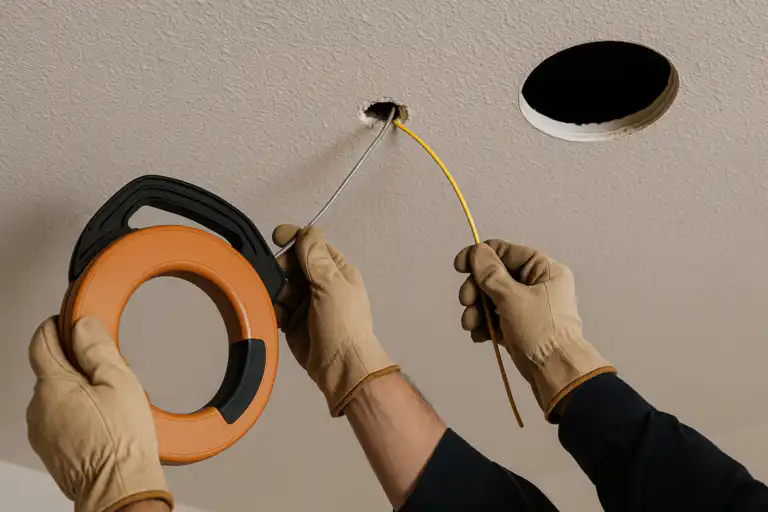
Running new electrical wiring in a ceiling with no attic access may seem daunting, but it’s entirely manageable using the right tools and techniques. Whether you’re rewiring for retrofit pot lights or adding a new lighting circuit, Durham Region electricians rely on a few key strategies to pull wire cleanly and safely through enclosed ceiling spaces—all while keeping your finish intact.
Use of fish tape and flexible drill bits
Fish tape is the go-to tool for maneuvering electrical wire through confined ceiling bays. After cutting the holes for your recessed lights, guide the fish tape from one opening to the next, pulling the wire along the path from switch to fixture. For longer or obstructed spans, a flexible drill bit can be used to bore through joists horizontally from hole to hole.
Step Tip: Use a lightweight fish tape for easier control across ceiling spans of up to 10ft.
Using existing switch boxes or cut-in boxes
To connect new pot lights to your existing electrical system, electricians often leverage nearby switch boxes or install cut-in remodel boxes to provide feed points. These allow for new wire runs while keeping everything accessible and code-compliant. It’s important to confirm that the circuit can handle additional fixture loads before tapping in. In most Ontario homes, 15-amp lighting circuits allow up to eight LED pot lights with ease.
Tips for avoiding cross-beams and insulation
Ceilings in older homes may contain fire-blocking cross-members or batt insulation—both of which can impede wire runs. To navigate these, electricians use inspection cameras or push rods to probe bays before fishing. Avoid compressing insulation or displacing vapor barriers, as this can affect home energy efficiency and violate code. IC-rated lights solve many of these concerns by allowing contact with insulation without overheating.
Take your time fishing wires—it’s more about feel than speed. Listen and move slowly.
Wiring without attic access just takes the right tactics. With good layout planning and a steady hand, you can safely power all your new pot lights without cutting up your ceiling.
“`html
Code Compliance, Permits & Safety Tips in Ontario

Wilson Electric Inc ensures code-compliant pot light installations even in ceilings with no attic access across Whitby and Durham Region.
Thinking about adding recessed pot lights without attic access in your Whitby home? While the finished ceiling can make DIY tempting, Ontario’s strict electrical regulations must be followed at all times. Failure to do so can mean fines, failed inspections—or worse, safety hazards behind your walls.
When you need a permit for lighting work in Whitby
Any modification involving electrical wiring, particularly the addition of new circuits or relocation of junction boxes, typically requires a permit under the Electrical Safety Authority (ESA) guidelines. If you’re not simply swapping fixtures, play it safe—file a notification with the ESA and have accredited inspections if required. This applies especially when you’re cutting into finished ceilings or penetrating vapour barriers.
Ontario hydro inspections may be required for new circuits or wiring alterations—check before you start.
Overview of Ontario Electrical Code basics
The Ontario Electrical Safety Code (OESC) outlines critical requirements for pot light installations—especially when no attic access exists. To minimize fire hazards, only IC-rated recessed fixtures should be used near insulation. Fixture spacing, load balancing on existing circuits, and proper protection of cut drywall areas are all governed by clear code mandates. All box-term connections and cable routing must be safely accessible and meet spacing from combustible materials.
Common safety concerns to be aware of
- Overloaded circuits from too many added fixtures
- Breached vapor barriers leading to moisture or air leaks
- Improper use of non-fire-rated pot lights near insulation
- Improvised wiring methods violating code (like hidden junction boxes)
“Retrofit lighting jobs should always follow ESA regulations—even in DIY projects.” – Ryan Wilson
Bottom line: Just because the ceiling’s finished doesn’t mean it’s safer or simpler—always prioritize safety and code compliance over shortcuts.
For expert electrical services in Whitby and across Durham Region, trust Wilson Electric—Durham Region’s go-to licensed electricians—call +1 905-999-5509 or contact us online for a free estimate!
Cost Breakdown: DIY vs Hiring an Electrician
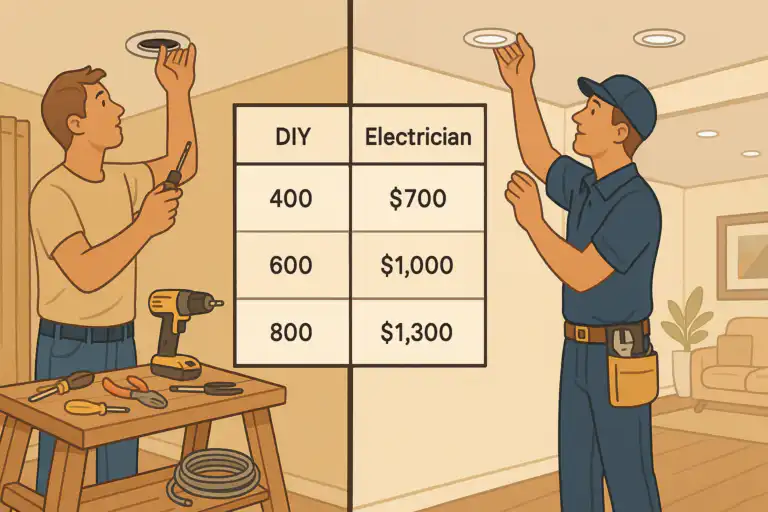
Compare the costs and expertise of DIY versus professional electricians when adding pot lights to existing ceilings without attic access in Whitby and the Durham Region.
If you’re weighing the cost of a DIY pot light install against hiring a licensed electrician in Whitby, you’re not alone. Budget is a top concern—but consider the long-term return on safety, compliance, and peace of mind. Here’s a detailed breakdown to guide your decision.
DIY material & tool costs (based on 4-light install)
To tackle pot light replacement or installation on your own, expect to spend between $200–$500 on materials and tools:
- IC-rated LED retrofit pot lights
- Wire (NMD90), connectors, and electrical boxes
- Fish tape or flexible drill extension for pathing wire
- Drywall saw and patch kits
- Voltage testers and safety gear (gloves, goggles)
Keep in mind—you’ll also need to pull permits for any new wiring and may face inspection fees.
Labour estimate for hiring a pro (4–8 pot lights)
In Whitby, professional pot light installation in ceilings without attic access typically runs from $600 to $1,600 based on fixture quantity, ceiling access, and panel condition. This includes laboured drilling, ESA-compliant wiring, code-tested connections, and fixture mounting that won’t damage your vapor barrier or joists.
Whitby homeowners can expect pro installation costs to range between $600–$1,600 depending on light count.
When paying a pro saves money and stress
Going DIY may seem financially friendly—until a misplaced cut hits a duct or failed inspection means redrilling. Many homeowners in the Durham Region call us after hitting hidden snags: knob-and-tube wiring, insulation obstructions, or outdated panels. ESA callbacks not only cost time, but often negate your initial savings.
DIY costs may be lower—but troubleshooting surprises or ESA callbacks often negate savings.
For expert electrical services in Whitby and across Durham Region, trust Wilson Electric—Durham Region’s go-to licensed electricians—call +1 905-999-5509 or contact us online for a free estimate!
Final Tips and When to Call a Licensed Electrician

A Wilson Electric Inc technician greets a satisfied homeowner after expertly adding pot lights to an existing ceiling without attic access in Whitby.
You’ve researched, compared, and maybe even started your install—so where do most Whitby homeowners go wrong with pot lights in finished ceilings? Here are the critical final checkpoints to ensure your lighting project is safe, stunning, and stress-free.
Common post-install issues (flicker, overload)
Improper pot light installs often result in sporadic flickering or dimming tied to overloaded circuits, especially when tapping off kitchen or bathroom lines. Non-IC-rated fixtures close to insulation may also overheat and trip breakers. And don’t forget to confirm all dimmers are LED-compatible if you’re upgrading to modern low-wattage lights.
How to know if a panel upgrade is also needed
If your electrical panel is maxed out—or if your home still operates on fuses or 100Amp service—a panel upgrade may be necessary to add more lighting safely. In Durham Region homes over 25 years old, Wilson Electric technicians often identify capacity issues when planning recessed lighting layouts. They’ll provide a code-compliant upgrade path if needed.
Why certified electricians are worth it
60% of Whitby homeowners we visit have hidden fire risks due to amateur retrofit attempts. From buried junction boxes to reversed polarities, DIY installations frequently miss crucial electrical best practices. ESA-certified electricians bring the skills, diagnostic tools, and accountability that local homes demand—especially in no-attic installs where mistakes are difficult to reverse.
“When in doubt—call us. One 15-minute inspection could prevent years of issues.” – Ryan Wilson
For expert electrical services in Whitby and across Durham Region, trust Wilson Electric—Durham Region’s go-to licensed electricians—call +1 905-999-5509 or contact us online for a free estimate!
“`